

HSE and China’s Top Universities to Launch Large-Scale Research and Education Projects

As part of the official visit of Russian President Vladimir Putin to the People’s Republic of China, the HSE delegation led by Rector Nikita Anisimov concluded new cooperation agreements with major Chinese universities. The agreements are designed to expand bilateral partnerships in education, science, and cultural exchange.
During the visit, the HSE University delegation met with the leadership of Tsinghua University, Peking University, and Beijing University of Technology, China’s top scientific and educational centres.

HSE Rector Nikita Anisimov
‘The strong overcome obstacles, and the wise overcome the entire journey. Cooperation with leading Chinese universities not only opens up new horizons in scientific research and knowledge exchange for Russian universities but also reinforces our position in the international educational space, serving as a key component of humanitarian cooperation between the Russian Federation and the People’s Republic of China. Together with our Chinese partners, today we took another important step towards mutual progress and prosperity.’
During the negotiations with our Chinese partners, two key agreements were signed. The first agreement with Tsinghua University focuses on the development of joint projects in the field of biology, ranging from molecular and computational neuroscience to AI-assisted big data analysis. This includes the formation of research groups, preparation of research publications, organization of internships for undergraduates and doctoral students, as well as holding of scientific and educational events. HSE doctoral students will have the opportunity to take internships at Tsinghua, while undergraduates will gain access to new academic mobility formats. The two universities also plan to launch dual degree programmes.
The academic exchange agreement signed with Peking University provides for an annual exchange of undergraduate and doctoral students. This document stipulates the procedures for selecting and assisting participants, their accommodation, administrative and visa support, and academic integration at the host institution. The agreement was published on the Kremlin website as one of the documents signed following the talks between the leaders of Russia and China.
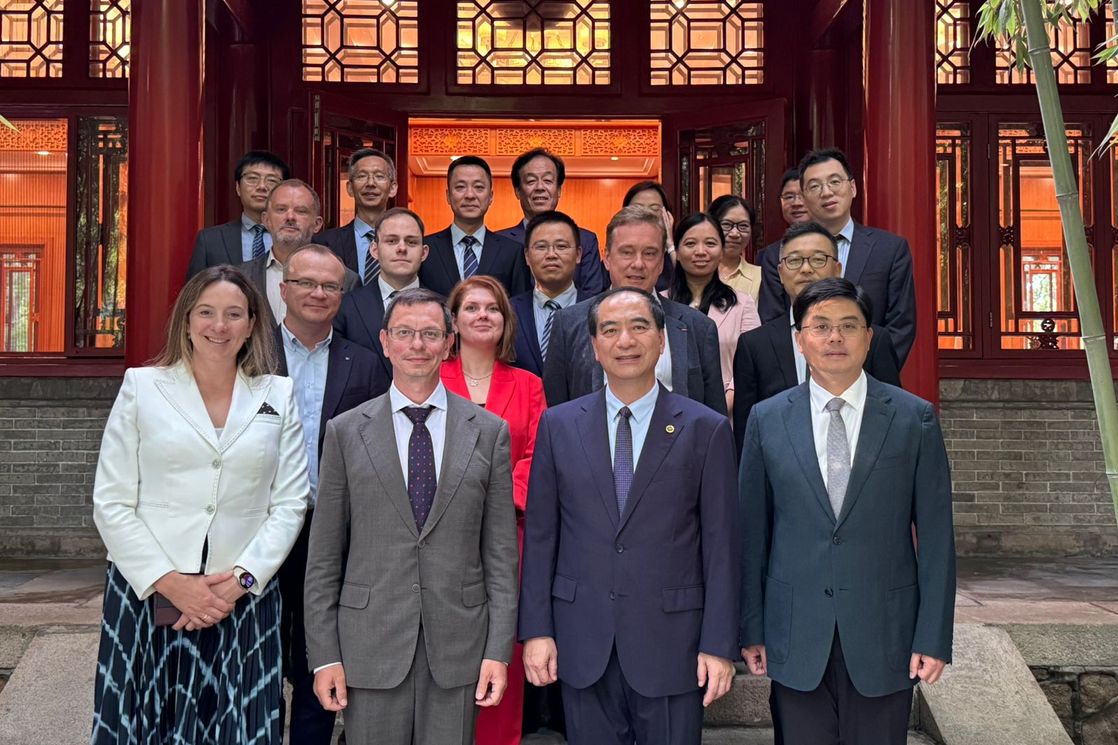
In addition, during their visit, HSE representatives held separate meetings with Peking University units—in particular, with the School of Physics and the School of Management. They discussed the prospects for launching joint educational programmes, developing research initiatives, and participating in international grant competitions. The meetings were attended by HSE Vice Rector Victoria Panova, HSE MIEM Vice Rector and Director Dmitry Kovalenko, HSE MIEM Professor Andrey Vasenko, Dean of the HSE Faculty of Computer Science Ivan Arzhantsev, and Dean of the HSE Faculty of World Economy and International Affairs Anastasia Likhacheva.
The development of humanitarian cooperation and cultural exchange was among the key topics discussed at all the venues. The parties expressed interest in expanding programmes for learning Chinese in Russia and Russian in China, supporting youth initiatives and deepening academic dialogue between university communities.
HSE representatives also met with the university’s students and graduates studying or working in China. During their informal conversation, they shared experiences of participating in academic mobility programmes, talked about their professional plans, and discussed opportunities for future joint projects.

See also:

Scientists Develop New Solution for 6G Communication Systems
A terahertz neuromorphic circuit developed by scientists at HSE University could make 6G communication systems both more accurate and energy-efficient. The circuit enables indoor tracking of mobile devices with an accuracy of up to 99%. The results were presented at PIERS 2026, an international symposium on Photonics and Electromagnetism held in China.
Researchers Develop Method for Direct Generation of Regulatory DNA
Researchers at HSE University have developed a model for generating promoters and enhancers—DNA sequences that regulate gene activity. The model works directly with DNA nucleotides, without first transforming them into a continuous numerical representation. This solution could be useful for applications in synthetic biology and gene therapy. The study results were presented at the ICLR 2026 Workshop ‘Generative AI in Genomics (Gen^2): Barriers and Frontiers.’
Researchers at HSE University and Sber Train Neural Networks to Better Predict User Preferences
The HSE FCS AI and Digital Science Institute and Sber have introduced a new architecture for recommendation systems that combines two classes of models, enabling algorithms to better predict users’ interests and needs. A preprint of the paper has been published on arxiv.org and presented at Urban ML.
HSE Graduate School of Business and Alfa-Bank Hold Summer School for Students from China
Twenty-seven students from Chinese universities took part in the international summer school ‘Digital Product Management’ organised by the HSE Graduate School of Business and Alfa-Bank. Over the course of a week, participants explored the Russian economy and business environment, learned about current technology trends, and worked through the key stages of digital product development step by step—from researching user needs and defining a problem to developing a prototype and presenting their final project.
Physicists Discover What Happens Inside a Stable Vortex
Large vortices with characteristic spiral arms are often observed in the atmosphere and the ocean. Physicists from HSE University have explained how these structures form and why they retain their shape. The researchers found that velocities at points located along the same vortex arc remain correlated even over long distances. At the same time, this correlation weakens rapidly with increasing distance from the vortex centre. These differences help explain the formation of spiral arms and may improve models of atmospheric and oceanic currents. The findings have been published in Physical Review Fluids.
HSE Computer Science Researchers Win Gold Medal at International Machine Learning Competition
A team comprising HSE International Laboratory of Statistical and Computational Genomics researchers Aleksei Shmelev and Nikita Chervov, 2025 graduate of the HSE Faculty of Computer Science’s Master’s programme in Data Analysis in Biology and Medicine Ivan Gevorkov, and two students from the United States achieved an outstanding result at the 2026 NeuroGolf international machine learning championship. The team won a gold medal and placed seventh overall.
‘Working with AI Solves a Wide Range of Engineering Problems’
Artificial intelligence is a working tool based on a balanced combination of algorithms and engineering. Experts and doctoral students from the HSE Moscow Institute of Electronics and Mathematics explain how AI technologies can improve an application, device, or system, and what engineering tasks are solved in the process.
‘The Peak of Stupidity’ and ‘The Valley of Despair’: HSE Economists Propose an Explanation for the Dunning–Kruger Effect
The Dunning–Kruger effect, which describes a sharp surge in self-confidence among beginners followed by an equally rapid decline as they gain experience, can be explained by the nature of the learning process and the acquisition of new knowledge. This conclusion was reached by Andrey Vorchik of the HSE Faculty of Economic Sciences together with independent researcher Murat Mamyshev. They developed a mathematical model of learning and demonstrated how subjective confidence is formed and changes as knowledge accumulates, as well as how teachers can reduce the ‘valley of despair’ experienced by learners.
Advancing Collaboration: HSE Faculty of Computer Science and Harbin Institute of Technology Hold Joint Seminar
From July 13 to 16, 2026, the Faculty of Computer Science hosted the Russian–Sino Research Seminar on Machine Learning Applications, organised by the HSE Laboratory for Cloud and Mobile Technologies in partnership with the Harbin Institute of Technology (China). A delegation comprising seven students and three university representatives travelled to Moscow to take part in an intensive four-day programme.
‘There’s a Big Practical Component in My Programme—That’s Especially Important in This Field’
Zou Jiaxu moved to Moscow from Heihe, China, at a young age. Having finished high school in Moscow, she decided to enrol in the Bachelor’s in Media Communications at the Institute of Media of the HSE Faculty of Creative Industries. Now in her second year of studies, Zou talked to the HSE News Service about the opportunities for practical experience available to HSE students, her volunteering and extracurricular activities, why learning Russian is a never-ending process, and the importance of making friends wherever you go.