

Cerium Glows Yellow: Chemists Discover How to Control Luminescence of Rare Earth Elements
.jpg "Cerium Glows Yellow: Chemists Discover How to Control Luminescence of Rare Earth Elements")
Researchers at HSE University and the Institute of Petrochemical Synthesis of the Russian Academy of Sciences have discovered a way to control both the colour and brightness of the glow emitted by rare earth elements. Their luminescence is generally predictable—for example, cerium typically emits light in the ultraviolet range. However, the scientists have demonstrated that this can be altered. They created a chemical environment in which a cerium ion began to emit a yellow glow. The findings could contribute to the development of new light sources, displays, and lasers. The study has been published in Optical Materials.
Rare earth elements are used in microelectronics, LEDs, and fluorescent materials because of their ability to emit light in precisely defined colours. This depends on how their electrons behave when absorbing and releasing energy.
When an atom absorbs energy—such as from light or an electric current—one of its electrons can be excited to a higher energy level. However, this excited state is unstable, and after a short time, the electron returns to its original level, releasing the excess energy as light. This process is known as luminescence.
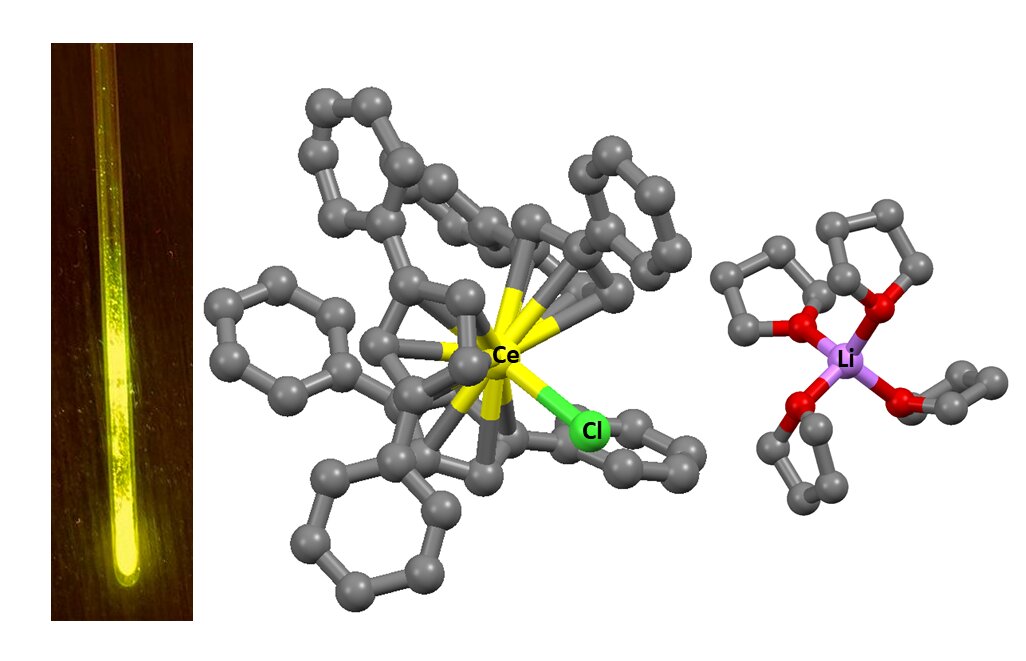
In rare earth elements, the glow results from electron transitions between 4f orbitals—regions around the atomic nucleus where electrons can reside. Typically, the energy of these transitions is fixed, meaning the colour of the glow remains constant: cerium emits invisible ultraviolet light, while terbium emits green. The 4f orbitals are situated deep within the atom and interact minimally with the surrounding environment. In contrast, the 5d orbitals are sensitive to external influences but generally do not contribute to the luminescence of lanthanides due to their excessively high energy.
However, scientists from HSE University and the Institute of Petrochemical Synthesis of the Russian Academy of Sciences have demonstrated that the colour of the radiation can be altered by adjusting the chemical environment of the metals. They synthesised cerium, praseodymium, and terbium complexes using organic ligands—molecules that surround metal ions. These ligands shape the geometry of the complex and influence its properties. In all cases, three cyclopentadienyl anions were symmetrically arranged around the metal. These anions consist of regular pentagons of carbon atoms, to which large organic fragments are attached, providing the required structure for the complex. This environment generates a specific electrostatic field around the ion, which alters the energy of the 5d orbitals and, consequently, affects the luminescence spectrum.

Daniil Bardonov
'Previously, a change in the colour of the glow had been observed, but the underlying mechanism was not understood. Now, in collaboration with our physicist colleagues, we have been able to understand the mechanism behind this effect. We deliberately designed compounds with an electronic structure that is atypical for lanthanides. Rather than focusing on a single example, we synthesised a series of compounds from cerium to terbium to observe how their properties change and to identify common patterns,' comments Daniil Bardonov, a master's student at the HSE Faculty of Chemistry.
In conventional compounds, cerium emits ultraviolet light with wavelengths between 300 and 400 nanometres. In the new complexes, its emission shifted to the red range, reaching up to 655 nanometres. This indicates that the energy gap between the 4f and 5d levels has decreased. A similar rearrangement of electronic levels was observed in the other lanthanides studied, also resulting in changes to their luminescence.

Dmitrii Roitershtein
'To understand how this process works, it’s important to first grasp the mechanism of energy transfer. Typically, a ligand molecule absorbs ultraviolet light, enters an excited state, and then transfers this energy to the metal atom, causing it to emit light,' explains Dmitrii Roitershtein, Academic Supervisor of the Chemistry of Molecular Systems and Materials Programme and co-author of the paper. 'However, in the new compounds, the process occurred differently: energy was transferred not directly to the 4f electrons, but via an intermediate 5d state.'
The researchers believe that being able to predict the luminescence spectrum will make it possible to design materials with desired properties more efficiently by eliminating the need for time-consuming trial and error. This could facilitate the creation of new and advanced light sources.
'We were able to demonstrate exactly how the environment of an atom influences its electronic transitions and lanthanide luminescence,' says Fyodor Chernenkiy, bachelor's student at the HSE Faculty of Chemistry. 'We can now intentionally select the structure of compounds to control luminescence and produce materials with specific optical properties.'
See also:

HSE Researchers Teach Neural Network to Distinguish Origins from Genetically Similar Populations
Researchers from the AI and Digital Science Institute, HSE Faculty of Computer Science, have proposed a new approach based on advanced machine learning techniques to determine a person’s genetic origin with high accuracy. This method uses graph neural networks, which make it possible to distinguish even very closely related populations.
HSE Economists Reveal the Secret to Strong Families
Researchers from the HSE Faculty of Economic Sciences have examined the key factors behind lasting marriages. The findings show that having children is the primary factor contributing to marital stability, while for couples without children, a greater income gap between spouses is associated with a stronger union. This is the conclusion reported in Applied Econometrics.
Fifteen Minutes on Foot: How Post-Soviet Cities Manage Access to Essential Services
Researchers from HSE University and the Institute of Geography of the Russian Academy of Sciences analysed three major Russian cities to assess their alignment with the '15-minute city' concept—an urban design that ensures residents can easily access essential services and facilities within walking distance. Naberezhnye Chelny, where most residents live in Soviet-era microdistricts, demonstrated the highest levels of accessibility. In Krasnodar, fewer than half of residents can easily reach essential facilities on foot, and in Saratov, just over a third can. The article has been published in Regional Research of Russia.
HSE Researchers Find Counter-Strike Skins Outperform Bitcoin and Gold as Alternative Investments
Virtual knives, custom-painted machine guns, and gloves are common collectible items in videogames. A new study by scientists from HSE University suggests that digital skins from the popular video game Counter-Strike: Global Offensive (CS:GO) rank among the most profitable types of alternative investments, with average annual returns exceeding 40%. The study has been published in the Social Science Research Network (SSRN), a free-access online repository.
HSE Neurolinguists Reveal What Makes Apps Effective for Aphasia Rehabilitation
Scientists at the HSE Centre for Language and Brain have identified key factors that increase the effectiveness of mobile and computer-based applications for aphasia rehabilitation. These key factors include automated feedback, a variety of tasks within the application, extended treatment duration, and ongoing interaction between the user and the clinician. The article has been published in NeuroRehabilitation.
'Our Goal Is Not to Determine Which Version Is Correct but to Explore the Variability'
The International Linguistic Convergence Laboratory at the HSE Faculty of Humanities studies the processes of convergence among languages spoken in regions with mixed, multiethnic populations. Research conducted by linguists at HSE University contributes to understanding the history of language development and explores how languages are perceived and used in multilingual environments. George Moroz, head of the laboratory, shares more details in an interview with the HSE News Service.
Slim vs Fat: Overweight Russians Earn Less
Overweight Russians tend to earn significantly less than their slimmer counterparts, with a 10% increase in body mass index (BMI) associated with a 9% decrease in wages. These are the findings made by Anastasiia Deeva, lecturer at the HSE Faculty of Economic Sciences and intern researcher in Laboratory of Economic Research in Public Sector. The article has been published in Voprosy Statistiki.
Scientists Reveal Cognitive Mechanisms Involved in Bipolar Disorder
An international team of researchers including scientists from HSE University has experimentally demonstrated that individuals with bipolar disorder tend to perceive the world as more volatile than it actually is, which often leads them to make irrational decisions. The scientists suggest that their findings could lead to the development of more accurate methods for diagnosing and treating bipolar disorder in the future. The article has been published in Translational Psychiatry.
Scientists Develop AI Tool for Designing Novel Materials
An international team of scientists, including researchers from HSE University, has developed a new generative model called the Wyckoff Transformer (WyFormer) for creating symmetrical crystal structures. The neural network will make it possible to design materials with specified properties for use in semiconductors, solar panels, medical devices, and other high-tech applications. The scientists will present their work at ICML, a leading international conference on machine learning, on July 15 in Vancouver. A preprint of the paper is available on arxiv.org, with the code and data released under an open-source license.
HSE Linguists Study How Bilinguals Use Phrases with Numerals in Russian
Researchers at HSE University analysed over 4,000 examples of Russian spoken by bilinguals for whom Russian is a second language, collected from seven regions of Russia. They found that most non-standard numeral constructions are influenced not only by the speakers’ native languages but also by how frequently these expressions occur in everyday speech. For example, common phrases like 'two hours' or 'five kilometres’ almost always match the standard literary form, while less familiar expressions—especially those involving the numerals two to four or collective forms like dvoe and troe (used for referring to people)—often differ from the norm. The study has been published in Journal of Bilingualism.