

HSE University Strengthens Ties with Peking University

On July 21, 2025, representatives from Peking University led by Zhang Jin, Vice President of Peking University and Chancellor of Shenzhen Graduate School, paid a visit to HSE University. The delegation included forty students, teachers, and administrators. During their visit, leaders from both universities discussed potential areas for future collaboration, and representatives from three HSE University departments held meetings with Chinese students.
In the White Hall of Durasov House, members of the Chinese delegation were welcomed by Alexey Koshel, Vice Rector of HSE University. He expressed his gratitude to his guests for hosting the HSE delegation at Peking University in March, and stressed the importance of this visit as an opportunity to get to know each other better, identify shared interests, and initiate new joint projects.

Vice Rector emphasised that Peking University is rightfully considered one of the best universities in the world, and that developing cooperation with Chinese universities is a top priority for HSE University. He recalled that during the May visit of the Chinese delegation to Russia to commemorate the 80th anniversary of the Great Victory, Nikita Anisimov, HSE University Rector, and Gong Qihuang, President of Peking University, signed an agreement on cooperation in the fields of natural sciences and the establishment of a BRICS research platform in the presence of the leaders of Russia and China.
‘The signed agreements took our partnership to a new level, and our university staff are already working on new projects,’ said Alexey Koshel.
These include the joint research project ‘Development of Highly Efficient and Stable Perovskite Solar Cells,’ which was one of the winners of HSE University’s International Academic Cooperation competition in 2025. Another project is organising a joint section between HSE MIEM and Peking University’s College of Chemistry and Molecular Engineering at the International Conference on Quantum Materials and Technologies in Turkey in March. HSE University’s Faculty of Humanities is actively collaborating with Peking University’s School of Foreign Languages in the field of Russian studies, and HSE University’s Institute of Education maintains contact with colleagues from Peking University’s Graduate School of Education.
In turn, Zhang Jin, Vice President of Peking University and Chancellor of the Graduate School in Shenzhen, expressed his gratitude to Russian colleagues for their warm reception of the delegation, which included three additional working groups of students and teachers from Peking University. The first group met with representatives from HSE University’s Faculty of Chemistry, the second with representatives from the Faculty of World Economy and International Affairs, and the third group was received at the HSE MIEM building in Strogino.
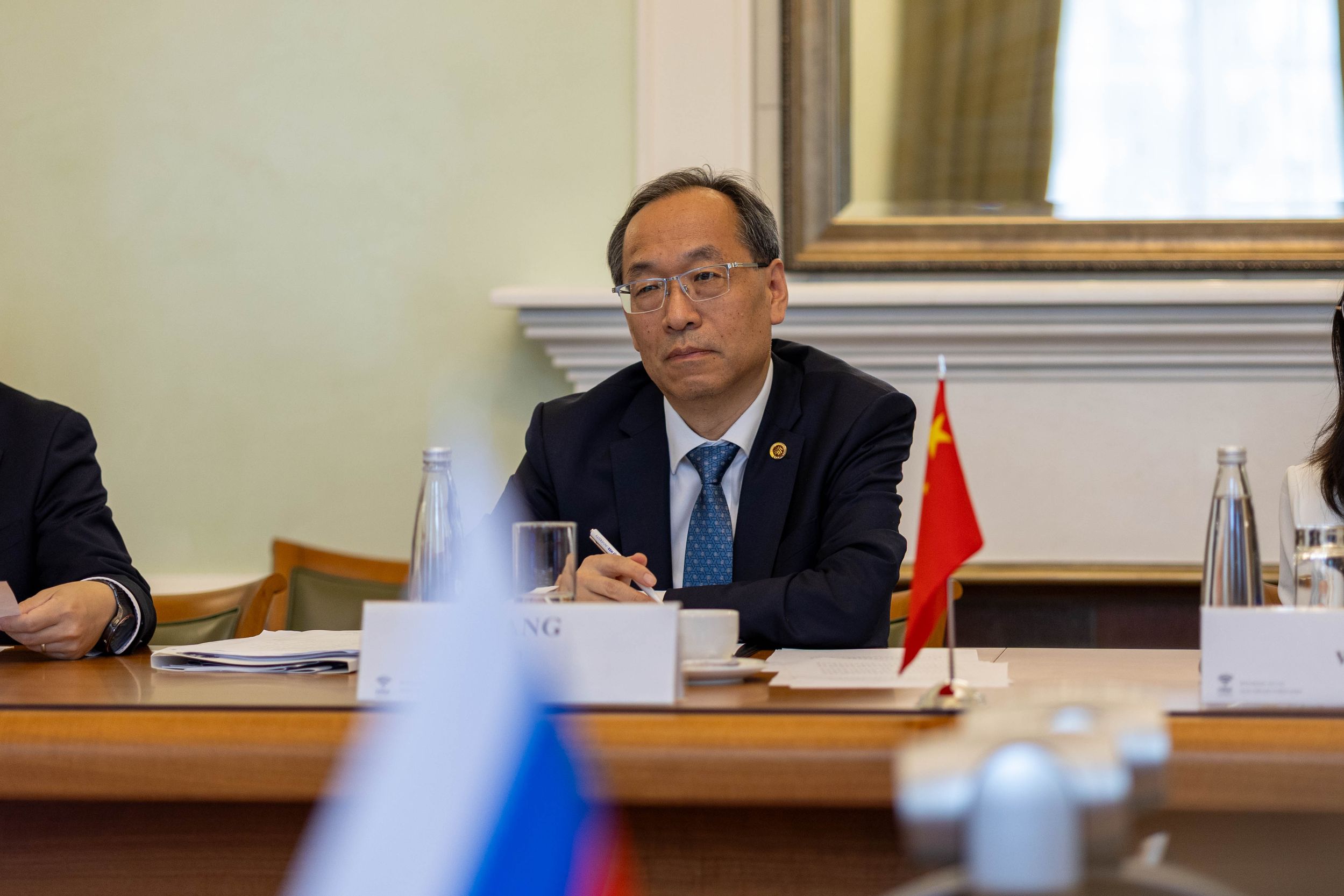
Professor Zhang described HSE University as one of the most significant partners in Russia and mentioned that it collaborates with Peking University in several fields. He introduced other attendees from China, who are in charge of cooperation in specific areas such as chemistry and materials science. He also shared his thoughts on the tour of the HSE University building on Pokrovsky Bulvar. ‘The library, dining area, and other spaces are very modern. It is clear that these were created for students,’ noted Vice President of Peking University.
He also mentioned the cooperation between the two universities, which takes place within the framework of interstate relations. He emphasised the need to expand academic exchanges and joint scientific work, taking into account the strengths of each institution. Professor Zhang suggested considering the possibility of creating a two-degree programme for graduate students, allowing them to spend half their time studying in China and the other half in Russia, with a supervisor from each country assigned to them.
In conclusion, he expressed hope that HSE University and Peking University could contribute significantly to strengthening the friendship between Russia and China.
Alexey Koshel thanked the distinguished guest for his kind words about HSE University and stressed that ‘truly significant projects are born through horizontal institutional collaboration between leading universities.’ Other members of the HSE University’s staff told the Chinese delegation about the future development of this collaboration.

Vitaly Kotov, Dean of HSE University’s Faculty of Chemistry, emphasised that five institutes of the Russian Academy of Sciences, which the faculty collaborates with in training students, should engage in joint projects with Peking University in the field of chemistry.
Alexei Vagov, Director of the Centre for Quantum Metamaterials at HSE MIEM, who had returned from Beijing the day before, supported the Chinese delegation’s proposal to organise student and postgraduate exchanges.

Yuriy Makhlin, Head of the International Laboratory for Condensed Matter Physics at HSE University and corresponding member of the Russian Academy of Sciences, spoke about his laboratory and the training of physics students at HSE University’s Faculty of Physics. He emphasised that this training was organised in collaboration with leading institutions of the Russian Academy of Sciences.
Marina Litvintseva, Director for Advanced Research at the HSE University, noted that within the framework of the university’s International Academic Cooperation project, HSE research centres and institutes had submitted 25 applications for joint work with Chinese colleagues in the past two years. One of these projects, with Peking University, was among the winners. ‘We would be happy to participate in the negotiations and initiate new projects to expand cooperation and the long-term agenda,’ she added.

See also:

Scientists Train Neural Network to Generate Process Plans from 3D Models
Researchers at the HSE FCS AI and Digital Science Institute have developed CAD2TechSpec, a framework that converts 3D models of mechanical parts into machining process plans—step-by-step instructions for machine tools. The solution aims to reduce the time required for the design and preparation of technical process documentation in mechanical engineering, aircraft manufacturing, and other high-tech industries. The study findings have been published in PeerJ Computer Science.
Biologists Discover 'Molecular Fingerprint' of Preeclampsia
Researchers at HSE University employed a new method to model hypoxia in placental cells during pregnancies complicated by preeclampsia and identified molecular markers of tissue hypoxia. Since hypoxia is one of the key mechanisms underlying preeclampsia, these findings are important for a more accurate and timely diagnosis of the disease and for the development of effective treatment methods. The paper has been published in Placenta.
‘Hedgehog’ Versus ‘Relatives’: Researchers Measure How the Brain Responds to Unexpected Words During Natural Speech
Russian neurophysiologists, including researchers from HSE University, have demonstrated the feasibility of using event-related fields (ERFs) to study brain activity during natural speech perception. The researchers showed that this approach can be applied not only to individual words but also to continuous speech. Their findings indicate that words whose meanings differ significantly from the preceding context require longer processing times. The study also reveals that the brain processes function words in two stages: first, it identifies their grammatical role and then uses this information to predict the next word. The study has been published in Frontiers in Human Neuroscience.
Hybrid Intelligence: Competencies in the Age of AI Discussed at Technoprom-2026
Artificial intelligence is not creating new professions, but rather transforming the nature of existing ones. This was the conclusion reached by participants in the panel session ‘Hybrid Intelligence: Digital and Human Drivers of Development,’ organised by the Institute for Statistical Studies and Economics of Knowledge (ISSEK) at HSE University as part of the 13th International Forum of Technological Development (Technoprom-2026). The experts discussed how the nature of work is changing, which skills are becoming increasingly sought after, and what prevents companies from fully capitalising on new technologies.
Scientists Develop New Solution for 6G Communication Systems
A terahertz neuromorphic circuit developed by scientists at HSE University could make 6G communication systems both more accurate and energy-efficient. The circuit enables indoor tracking of mobile devices with an accuracy of up to 99%. The results were presented at PIERS 2026, an international symposium on Photonics and Electromagnetism held in China.
Scientists Develop Algorithm for More Reliable Processors in Data Centres
Researchers from HSE MIEM and Samara University have developed the LRF-3D algorithm to automatically bypass idle nodes in three-dimensional networks-on-chip. Thanks to its hierarchical architecture, the algorithm outperforms existing solutions in both speed and path accuracy, improving processor reliability for use in data centres, supercomputers, and AI computing. The source code and test results are publicly available.
Researchers Develop Method for Direct Generation of Regulatory DNA
Researchers at HSE University have developed a model for generating promoters and enhancers—DNA sequences that regulate gene activity. The model works directly with DNA nucleotides, without first transforming them into a continuous numerical representation. This solution could be useful for applications in synthetic biology and gene therapy. The study results were presented at the ICLR 2026 Workshop ‘Generative AI in Genomics (Gen^2): Barriers and Frontiers.’
Researchers at HSE University and Sber Train Neural Networks to Better Predict User Preferences
The HSE FCS AI and Digital Science Institute and Sber have introduced a new architecture for recommendation systems that combines two classes of models, enabling algorithms to better predict users’ interests and needs. A preprint of the paper has been published on arxiv.org and presented at Urban ML.
HSE Graduate School of Business and Alfa-Bank Hold Summer School for Students from China
Twenty-seven students from Chinese universities took part in the international summer school ‘Digital Product Management’ organised by the HSE Graduate School of Business and Alfa-Bank. Over the course of a week, participants explored the Russian economy and business environment, learned about current technology trends, and worked through the key stages of digital product development step by step—from researching user needs and defining a problem to developing a prototype and presenting their final project.
Physicists Discover What Happens Inside a Stable Vortex
Large vortices with characteristic spiral arms are often observed in the atmosphere and the ocean. Physicists from HSE University have explained how these structures form and why they retain their shape. The researchers found that velocities at points located along the same vortex arc remain correlated even over long distances. At the same time, this correlation weakens rapidly with increasing distance from the vortex centre. These differences help explain the formation of spiral arms and may improve models of atmospheric and oceanic currents. The findings have been published in Physical Review Fluids.