

‘Student Ideas Shed Light on Key Challenges for Urban Development’

The first international joint summer school of the Vysokovsky Graduate School of Urbanism (GSU) at both the HSE Faculty of Urban and Regional Development and Brest State Pushkin University (BrSU), hosted by BrSU, has come to a close. The programme focused on studying buffer zones along the railway lines encircling the city centre. Participants included students from the GSU’s Urban Planning degree programme, as well as students from BrSU and Brest State Technical University.
Nineteen participants of the joint summer school completed a lecture course, carried out field research, worked in themed groups, and successfully defended their projects.
In their fieldwork, students explored the area and its history, collected up-to-date data from open sources and through on-site observations, and then moved on to group project work.

Maxim Bogdasarov
‘This is the first urban studies summer school held at our university, and it is a natural stage in our cooperation with HSE University,’ said Maxim Bogdasarov, Vice Rector for Science and Professor at the Department of Urban and Regional Development at BrSU. ‘We are proud knowing that this initiative came from our Moscow partners, who have extensive experience in running various summer schools. We are especially pleased that Brest has been chosen as the location for our next joint project. This is an important step in developing our Urban Studies and City Management programme, as the work is practice-oriented, enabling us to learn together with our colleagues.’
The international summer school brought together HSE and two universities in Brest—Brest State Pushkin University and Brest State Technical University. Participants were divided into four teams, each comprising representatives from all three institutions. ‘This line-up created a powerful synergy, as students exchanged knowledge and experiences both formally and informally during project work and city exploration,’ noted Maxim Bogdasarov. ‘Each team presented their own vision of the identified challenge—the interaction between the railway system and the urban environment. It is young researchers who identify opportunities, limitations, and ways to overcome challenges. The results of their work are the school’s main achievement, as the goal was to encourage collaboration, gain new knowledge from lecturers, study the city’s territory, and become familiar with the specifics of railway operations.’
The school’s participants visited Brest-Central and Brest-North stations, worked alongside railway staff, and gained valuable experience. ‘Now we look forward to seeing the fruits of their efforts, and I am convinced that the positive experiences will continue. Our Moscow guests spoke highly of Brest’s atmosphere and expressed their desire to carry on with such projects in the future,’ said Maxim Bogdasarov.


He also emphasised the active development of cooperation between Brest State Pushkin University and HSE University: ‘We have previously held a week dedicated to challenges in “smart” cities, and now we have organised a school on the interaction between railway infrastructure and urban spaces. I am sure there are many more promising opportunities for joint research, discussions, and exchange of ideas.’
The four teams developed conceptual projects, each focusing on a different section of the railway area. In the western zone, which borders the city’s main landmark, the Brest Fortress, participants proposed enhancing recreational and commercial activities, filling an almost empty part of the city and bridging both the physical and conceptual gap between the city centre and the fortress.
On the eastern side, where there is dense multi-storey and detached housing, the team proposed making a creative cluster with offices and affordable rental spaces for local artisans in the building of a former furniture factory. The northern team focused on the area around the main railway station and, in addition to improving connectivity, suggested highlighting the historical importance of the railway for Brest through tourist routes and dedicated sites. One team worked on a special area in the north-east, where they fully unleashed their imagination towards gentrified development, proposing the construction of a large business centre.
All students’ presentations were evaluated by Maksim Klimanov, an expert from the Vysokovsky Graduate School of Urbanism; Associate Professors Anna Karoza and Sergei Zarutski from BrSU; and Tatiana Panchenko, Director of the Brest City Centre for Architecture and Construction.

Vlad Kotvin
‘Brest is a growing city, but it aims to develop in a compact manner and increase its density, as this is the most efficient way to make use of its infrastructure,’ said Vlad Kotvin, a second-year student of the Urban Planning programme at the Vysokovsky Graduate School of Urbanism, HSE University. ‘Our team was convinced that such potential lies near the railway. These lands are already populated, so it is essential to strike a balance between public interests and residents’ rights to a comfortable living environment.’
This project was his first teamwork experience. ‘Every team member brought unique skills to the table: architects, urban planners, and urban studies specialists were able to show their strengths thanks to clear task allocation,’ he noted. ‘This allowed us to focus on specific objectives and appreciate the significance of our contributions.’
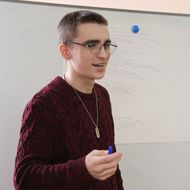
Vitaly Sirotin
Vitaly Sirotin, a third-year student of the Tourism and Hospitality programme at BrSU, collaborated with his team to analyse and enhance transport links between the city’s railway and bus stations. ‘Our area is rich in historic landmarks and tourist attractions, which we also worked with actively, proposing ideas for their integration into the urban fabric. Residents often mentioned there was nothing to do at the station, so we suggested bringing station complexes into city life by improving accessibility and organising interesting events,’ emphasised Vitaly Sirotin.
He enjoyed the teamwork experience: ‘The school was not only fun but also productive; the guys were excellent specialists and true professionals in their fields. Special thanks go to the lecturers from the Vysokovsky Graduate School of Urbanism for their memorable talks.’

Tatiana Demidova
The project of Tatiana Demidova’s team, a second-year student of the Urban Planning programme at the Vysokovsky Graduate School of Urbanism, HSE University, involved rethinking spaces influenced by railway infrastructure. ‘We viewed Brest-Central not simply as a transport hub but rather as an important historic landmark. Our task was to highlight the cultural significance of the railway station and its surroundings,’ said the student. Her team proposed creating tours with audio guides and a navigation system for the city’s central district: ‘We also included entirely new elements in the tour programme—light installations on building and carriage façades, an outdoor interactive railway museum, restored water towers, and, of course, the magnificent railway station itself.’
The summer school gave her invaluable experience, fresh knowledge, and new connections. ‘The most important thing I personally learned was how to work effectively in a team with set objectives, goals, and deadlines, as well as to grow from mistakes and carry out my work with confidence,’ she said.

Maksim Babenko
‘The essence of our project was to develop a plan for improving the buffer space near the railway in Brest,’ said Maksim Babenko, a third-year student at Brest State Technical University. ‘We split into teams and worked on specific parts of the area, conducting interviews with local residents, researching property prices, and analysing the current level of development.’
For Maksim, the experience at the summer school was incredibly inspiring. ‘The tutors immersed us in the work process, offered valuable advice, helped us form effective teams, and supported us throughout the summer school programme.’

Diana Kodzokova, Deputy Dean for Research of the HSE Faculty of Urban and Regional Development, Tutor of the Summer School
‘Many of the student ideas are ambitious, yet they shed light on key challenges for the city centre’s further development. Brest has a unique railway history and stands at a crossroads between Europe and Asia. It was important not only to focus on the constraints imposed by such infrastructure on spatial development, but also to view our site through the lens of values. This approach allowed the students to develop proposals for tourist routes, museum and exhibition programmes, and the use of railway facilities in the city’s festival agenda, such as on Railway Workers’ Day. These solutions require minimal investment and represent “quick wins” for the city in boosting its tourist appeal.’

See also:

HSE Graduate School of Business and Alfa-Bank Hold Summer School for Students from China
Twenty-seven students from Chinese universities took part in the international summer school ‘Digital Product Management’ organised by the HSE Graduate School of Business and Alfa-Bank. Over the course of a week, participants explored the Russian economy and business environment, learned about current technology trends, and worked through the key stages of digital product development step by step—from researching user needs and defining a problem to developing a prototype and presenting their final project.
Physicists Discover What Happens Inside a Stable Vortex
Large vortices with characteristic spiral arms are often observed in the atmosphere and the ocean. Physicists from HSE University have explained how these structures form and why they retain their shape. The researchers found that velocities at points located along the same vortex arc remain correlated even over long distances. At the same time, this correlation weakens rapidly with increasing distance from the vortex centre. These differences help explain the formation of spiral arms and may improve models of atmospheric and oceanic currents. The findings have been published in Physical Review Fluids.
HSE University–St Petersburg Hosts Record Number of International Students at International Summer School
The HSE University–St Petersburg Summer School brought together about 50 students from ten countries. The participants studied political geography, modern Russian culture and language, statistical analysis, and intercultural communications. Read on to find out what opportunities HSE University–St Petersburg offers international students.
‘The Peak of Stupidity’ and ‘The Valley of Despair’: HSE Economists Propose an Explanation for the Dunning–Kruger Effect
The Dunning–Kruger effect, which describes a sharp surge in self-confidence among beginners followed by an equally rapid decline as they gain experience, can be explained by the nature of the learning process and the acquisition of new knowledge. This conclusion was reached by Andrey Vorchik of the HSE Faculty of Economic Sciences together with independent researcher Murat Mamyshev. They developed a mathematical model of learning and demonstrated how subjective confidence is formed and changes as knowledge accumulates, as well as how teachers can reduce the ‘valley of despair’ experienced by learners.
Advancing Collaboration: HSE Faculty of Computer Science and Harbin Institute of Technology Hold Joint Seminar
From July 13 to 16, 2026, the Faculty of Computer Science hosted the Russian–Sino Research Seminar on Machine Learning Applications, organised by the HSE Laboratory for Cloud and Mobile Technologies in partnership with the Harbin Institute of Technology (China). A delegation comprising seven students and three university representatives travelled to Moscow to take part in an intensive four-day programme.
HSE and Karakalpak State University Agree on Cooperation
HSE University and Berdakh Karakalpak State University have signed a cooperation agreement to strengthen collaboration in research, education, and innovation. Through the expertise of its Сentre of Digital Technologies for Nature-Based Solutions of the Carbon Measurement Supersites Programme, HSE University will work with colleagues from Uzbekistan to assess climate risks and evaluate opportunities for implementing nature-based climate projects in the region. The partners also plan to develop joint research and educational programmes.
ICEF International Summer School 2026 Brings Together Students from Partner Universities
From July 5 to 15, 2026, HSE ICEF hosted its Second International Summer School in Economics and Finance, welcoming students from partner universities around the world. The programme brought together thirty bachelor’s and master’s students from China, Turkey, Vietnam, Malaysia, Uzbekistan, and Russia, offering a balanced blend of intensive academic training and rich cultural experiences. The academic component was delivered by ICEF and HSE faculty, along with industry experts in economics and financial markets.
International Dialogue and New Approaches: Highlights from Fudan University’s Summer School
At the beginning of July 2026, students from the HSE Faculty of World Economy and International Affairs took part in the Summer School on International Relations organised by Fudan University (China), one of the leading international educational programmes in this field. Over the course of two weeks, they explored contemporary approaches to global governance and the development of the Global South, attended lectures by renowned scholars from around the world, and discussed current international issues with fellow students from across the globe.
‘We Are Always Open to Collaboration, and China Is One of Our Most Important Partners’
From July 20 to 27, 2026, the HSE Faculty of Urban and Regional Development (FURD) is hosting a summer school for students from Tianjin University dedicated to the preservation of cultural heritage. Throughout the week, participants have attended lectures, practical workshops, and field visits to some of Moscow’s most iconic heritage sites. The summer school is the faculty’s first international programme of this kind and forms part of the expanding educational cooperation between Russia and China.
Physicists at HSE University and FIAN Discover Way to 'Photograph' Sound for Testing Materials Used in 6G Communications
Researchers at HSE University, in collaboration with colleagues from the Lebedev Physical Institute of the Russian Academy of Sciences (FIAN), have developed a method for rapidly determining how firmly a film is bonded to a substrate. This is important for the creation of ultrahigh-frequency acoustic filters, which are key components of next-generation 5G and 6G communications. For the first time, researchers have succeeded in measuring the lateral rigidity of the bond between a two-dimensional material film and a substrate in this way. The study results have been published in Applied Physics Letters.