

Russian Scientists Develop New Compound for Treating Aggressive Tumours
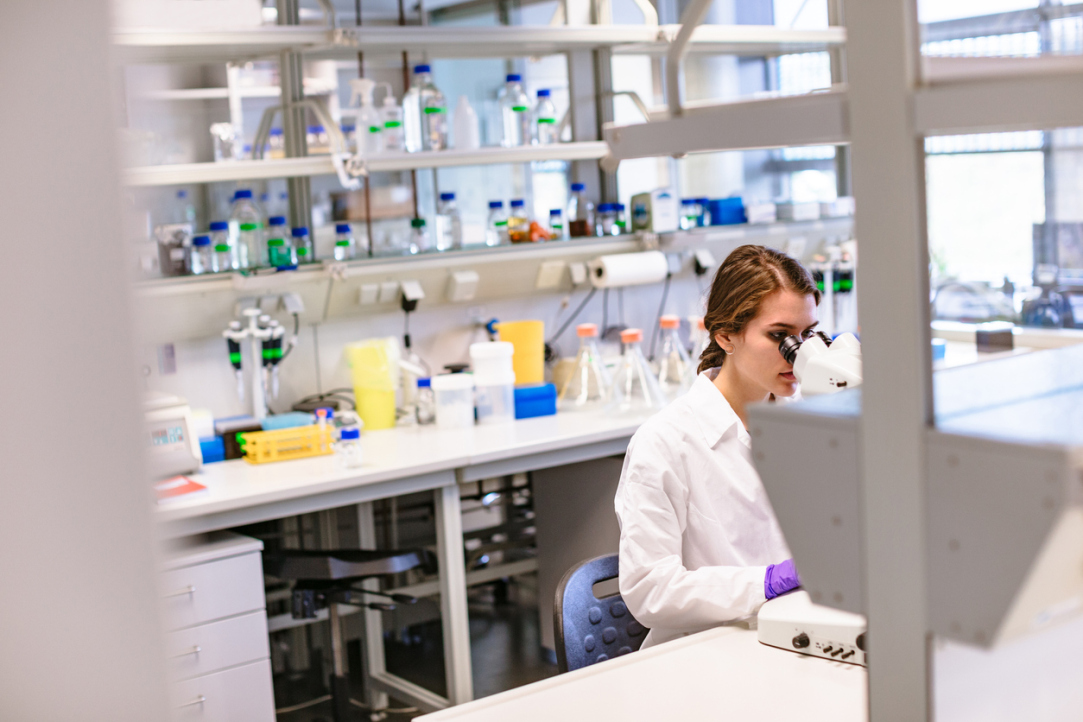
A team of Russian researchers has synthesised a novel compound for boron neutron capture therapy (BNCT), a treatment for advanced cancer that uses the boron-10 isotope. The compound exhibits low toxicity, excellent water solubility, and eliminates the need for administering large volumes. Most importantly, the active substance reaches the tumour with minimal impact on healthy tissues. The study was published in the International Journal of Molecular Sciences shortly before World Cancer Day, observed annually on February 4.
Boron neutron capture therapy (BNCT) is an advanced cancer treatment that leverages the properties of the boron-10 isotope. The method involves first saturating tumour cells with boron-10, followed by irradiation with thermal neutrons. This triggers a nuclear reaction that selectively destroys cancer cells while sparing healthy tissue. Thus, the treatment success largely depends on the compound's ability to effectively deliver boron-10 to the tumour and maintain the necessary boron concentration.
A team of scientists from the HSE Faculty of Chemistry, the Institute of General and Inorganic Chemistry of the Russian Academy of Sciences, and the N.N. Blokhin National Medical Research Centre of Oncology has developed three compounds that combine the closo-dodecaborate anion with amino acids containing a side-chain amino group. The molecules are structurally similar to natural amino acids, allowing them to 'trick' the body's transport systems into capturing and delivering them to cells, including cancer cells. This makes the substance effective at targeting tumours, where it accumulates.
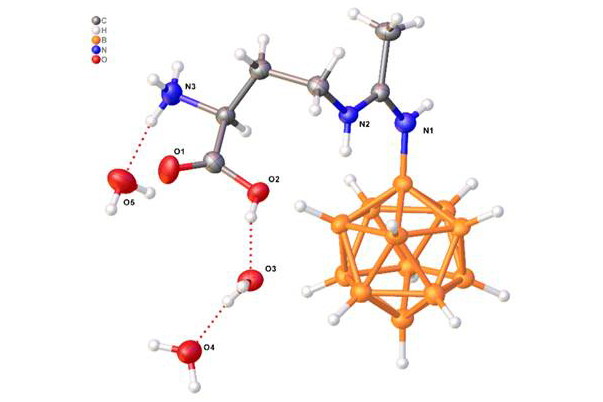
One of the compounds demonstrated low toxicity, with the half-lethal dose (LD50) for experimental animals ranging from 150 to 300 mg per kilogram of body weight. In experiments, the compound not only demonstrated the ability to accumulate boron in tumour tissues but also confirmed its effectiveness in animals. When administered to laboratory mice, the boron concentration in melanoma tumour cells was six times higher than in healthy tissues after 45 minutes.
The compound can exist in two forms depending on the pH level. The first form is a sodium salt, which is highly soluble in water under conditions close to physiological pH, making it convenient for therapeutic use. The second form occurs upon acidification, when the compound transforms into an insoluble internal salt useful for obtaining a medically pure product during the stages of synthesis, isolation, and purification.
Margarita Ryabchikova
'The aim of the study was to reduce toxicity and simplify the compound purification process, building on data from previous research. As a result, three new compounds were synthesised. One of them exhibited optimal characteristics: it does not cause significant side effects when administered intravenously and dissolves well in water, setting it apart from existing therapeutic drugs,' explains study author Margarita Ryabchikova, a third-year student at the HSE Faculty of Chemistry. 'We aimed not only for high efficacy but also for production convenience. The developed method can be easily scaled to produce the required quantities of the product while remaining economically viable.'
The study demonstrated that the new compound accumulates more effectively in the tissues of certain types of tumours compared to the currently used drug. This is an important step toward developing a safer and more accessible therapy. The research is still in its early stages, but this development has the potential to significantly improve cancer treatment outcomes and broaden the applications of boron neutron capture therapy in the fight against various types of tumours.
See also:

Scientists Rank Russian Regions by Climate Risk Levels
Researchers from HSE University and the Russian Academy of Sciences have assessed the levels of climate risks across Russian regions. Using five key climate risks—heatwaves, water stress, wildfires, extreme precipitation, and permafrost degradation—the scientists ranked the country’s regions according to their need for adaptation to climate change. Krasnoyarsk Krai, Irkutsk Region, and Sverdlovsk Region rank among the highest for four of the five climate risks considered. The study has been published in Science of the Total Environment.
HSE Researchers Teach Neural Network to Distinguish Origins from Genetically Similar Populations
Researchers from the AI and Digital Science Institute, HSE Faculty of Computer Science, have proposed a new approach based on advanced machine learning techniques to determine a person’s genetic origin with high accuracy. This method uses graph neural networks, which make it possible to distinguish even very closely related populations.
HSE Economists Reveal the Secret to Strong Families
Researchers from the HSE Faculty of Economic Sciences have examined the key factors behind lasting marriages. The findings show that having children is the primary factor contributing to marital stability, while for couples without children, a greater income gap between spouses is associated with a stronger union. This is the conclusion reported in Applied Econometrics.
Fifteen Minutes on Foot: How Post-Soviet Cities Manage Access to Essential Services
Researchers from HSE University and the Institute of Geography of the Russian Academy of Sciences analysed three major Russian cities to assess their alignment with the '15-minute city' concept—an urban design that ensures residents can easily access essential services and facilities within walking distance. Naberezhnye Chelny, where most residents live in Soviet-era microdistricts, demonstrated the highest levels of accessibility. In Krasnodar, fewer than half of residents can easily reach essential facilities on foot, and in Saratov, just over a third can. The article has been published in Regional Research of Russia.
HSE Researchers Find Counter-Strike Skins Outperform Bitcoin and Gold as Alternative Investments
Virtual knives, custom-painted machine guns, and gloves are common collectible items in videogames. A new study by scientists from HSE University suggests that digital skins from the popular video game Counter-Strike: Global Offensive (CS:GO) rank among the most profitable types of alternative investments, with average annual returns exceeding 40%. The study has been published in the Social Science Research Network (SSRN), a free-access online repository.
HSE Neurolinguists Reveal What Makes Apps Effective for Aphasia Rehabilitation
Scientists at the HSE Centre for Language and Brain have identified key factors that increase the effectiveness of mobile and computer-based applications for aphasia rehabilitation. These key factors include automated feedback, a variety of tasks within the application, extended treatment duration, and ongoing interaction between the user and the clinician. The article has been published in NeuroRehabilitation.
'Our Goal Is Not to Determine Which Version Is Correct but to Explore the Variability'
The International Linguistic Convergence Laboratory at the HSE Faculty of Humanities studies the processes of convergence among languages spoken in regions with mixed, multiethnic populations. Research conducted by linguists at HSE University contributes to understanding the history of language development and explores how languages are perceived and used in multilingual environments. George Moroz, head of the laboratory, shares more details in an interview with the HSE News Service.
Slim vs Fat: Overweight Russians Earn Less
Overweight Russians tend to earn significantly less than their slimmer counterparts, with a 10% increase in body mass index (BMI) associated with a 9% decrease in wages. These are the findings made by Anastasiia Deeva, lecturer at the HSE Faculty of Economic Sciences and intern researcher in Laboratory of Economic Research in Public Sector. The article has been published in Voprosy Statistiki.
Scientists Reveal Cognitive Mechanisms Involved in Bipolar Disorder
An international team of researchers including scientists from HSE University has experimentally demonstrated that individuals with bipolar disorder tend to perceive the world as more volatile than it actually is, which often leads them to make irrational decisions. The scientists suggest that their findings could lead to the development of more accurate methods for diagnosing and treating bipolar disorder in the future. The article has been published in Translational Psychiatry.
Scientists Develop AI Tool for Designing Novel Materials
An international team of scientists, including researchers from HSE University, has developed a new generative model called the Wyckoff Transformer (WyFormer) for creating symmetrical crystal structures. The neural network will make it possible to design materials with specified properties for use in semiconductors, solar panels, medical devices, and other high-tech applications. The scientists will present their work at ICML, a leading international conference on machine learning, on July 15 in Vancouver. A preprint of the paper is available on arxiv.org, with the code and data released under an open-source license.