

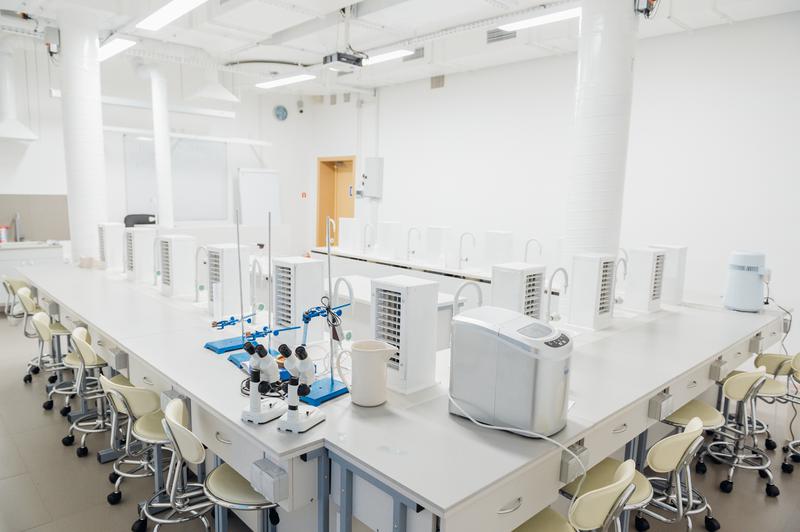
Russian Scientists Improve Water Purification Membranes Using Metal Ions
Researchers have proposed using polymer membranes modified with copper, zinc, and chromium metal ions for water purification. These polymers were used for the first time in water purification via electrodialysis. Copper-based membranes demonstrated record selectivity for monovalent ions, opening new possibilities for sustainable water recycling. The study has been published in the Journal of Membrane Science.
Scientists at HSE University Devise More Accurate Method for Predicting the Electrical Conductivity of Electrolyte Solutions
Researchers at HSE MIEM have developed a model for calculating the electrical conductivity of aqueous electrolyte solutions; for the first time, it considers the spatial distribution of ion charges instead of assuming their localisation at a single point. The model remains effective even at high electrolyte concentrations and across a wide temperature range. This breakthrough will contribute to the development of more efficient batteries and enable the calculation of electrical conductivity without the need for experimental testing. The study has been published in the Journal of Chemical Physics.
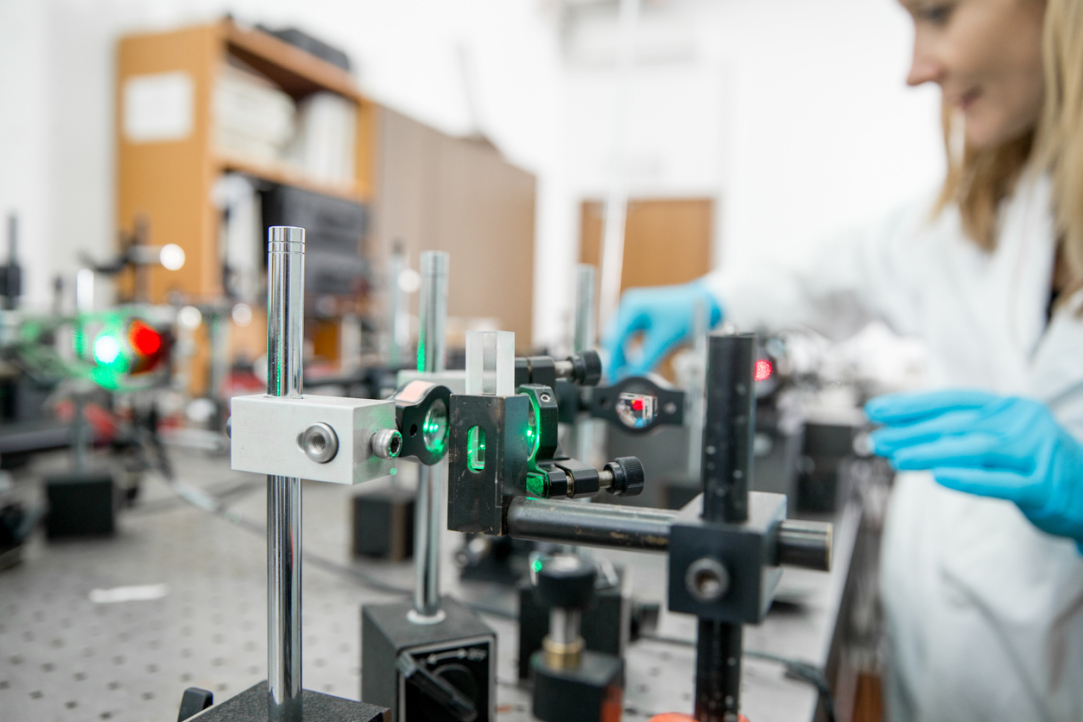
Russian Scientists Integrate Microdisk Laser and Waveguide on a Single Substrate
A group of Russian scientists led by Professor Natalia Kryzhanovskaya at HSE Campus in St Petersburg has been researching microdisk lasers with an active region based on arsenide quantum dots. For the first time, researchers have successfully developed a microdisk laser coupled with an optical waveguide and a photodetector on a single substrate. This design enables the implementation of a basic photonic circuit on the same substrate as the radiation source (microlaser). In the future, this will help speed up data transfer and reduce equipment weight without compromising quality. The study results have been published in Semiconductors.
Considering News Background Can Improve GDP Projections in Periods of Instability
The accuracy of Russian GDP forecasts during periods of instability improves in 45% of cases when news reports are taken into account. However, during more stable periods, this advantage nearly disappears. News provides an up-to-date view of the economy and enables quicker responses to emerging challenges. This was revealed by an analysis of over 500,000 news reports conducted by Ivan Stankevich and Natalia Makeeva of the HSE Faculty of Economic Sciences (FES), and Nikita Lyubaykin. The study results have been published in Voprosy Ekonomiki.

HSE Scientists Discover How to Predict Charitable Behaviour Through Physiological Reactions
Researchers at the HSE Institute for Cognitive Neuroscience have investigated how the emotional impact of advertising affects the amount people willing to donate to support animal welfare. To accomplish this, the researchers measured physiological responses such as heart rate, electrodermal activity, and facial expressions in individuals viewing various photos of dogs. The findings indicate that willingness to donate is most accurately predicted by heart rate and facial muscle activation. The study has been published in Social Psychology.

First Successful Attempt in 55 years: Physicists in Russia and Germany Confirm 1969 Experiment Results
A team of researchers, with the participation of physicists from HSE University, replicated the 1969 experiment on superconductivity and its properties. The scientists induced superconductivity by deliberately deteriorating the interfaces between the layers of superconductors and ferromagnets in the system, resulting in better performance of spin valves compared to the classical version, where the interfaces between the layers are ideal. This approach could lead to the development of more efficient devices for data storage and computing. The study findings have been published in the Beilstein Journal of Nanotechnology.

Esports Players Play Better Online
In competitions, esports players, like other athletes, face stress and show worse results due to pressure. A substantial decrease takes place in the performance of esports players during overtime. This effect, however, is significantly mitigated in online competitions compared to live events—the difference can reach 30%. A study by a team of authors from HSE University’s Moscow and Perm campuses and European University Viadrina (Germany) explores the phenomenon of choking under pressure within the context of esports. The study was published in the Journal of Economic Behavior & Organization.

Analysing Genetic Information Can Help Prevent Complications after Myocardial Infarction
Researchers at HSE University have developed a machine learning (ML) model capable of predicting the risk of complications—major adverse cardiac events—in patients following a myocardial infarction. For the first time, the model incorporates genetic data, enabling a more accurate assessment of the risk of long-term complications. The study has been published in Frontiers in Medicine.
HSE Researchers Develop Novel Approach to Evaluating AI Applications in Education
Researchers at HSE University have proposed a novel approach to assessing AI's competency in educational settings. The approach is grounded in psychometric principles and has been empirically tested using the GPT-4 model. This marks the first step in evaluating the true readiness of generative models to serve as assistants for teachers or students. The results have been published in arXiv.

Smoking Habit Affects Response to False Feedback
A team of scientists at HSE University, in collaboration with the Institute of Higher Nervous Activity and Neurophysiology of the Russian Academy of Sciences, studied how people respond to deception when under stress and cognitive load. The study revealed that smoking habits interfere with performance on cognitive tasks involving memory and attention and impairs a person’s ability to detect deception. The study findings have been published in Frontiers in Neuroscience.