

HSE University Students and Postgraduates Take Part in Peking University International Summer School

In July 2025, Peking University hosted its annual Quantum Molecular Dynamics Summer School, which has moved onto an international stage. Its first foreign guests were students and postgraduates from the HSE Tikhonov Moscow Institute of Electronics and Mathematics (MIEM). They took part in an extensive academic programme and had the opportunity to visit a laboratory that works with optoelectronic materials and energy devices.
The trip was organised under the cooperation agreement between Peking University and HSE University, with support from HSE’s Department of Internationalisation.
On the opening day, the organiser of the summer school, Professor Jian Liu, greeted the participants, giving special mention to the Russian students: ‘Today we have not only students from Chinese universities, but also from Russia. We are delighted to welcome them to Peking University and hope their participation will contribute to strengthening international cooperation.’
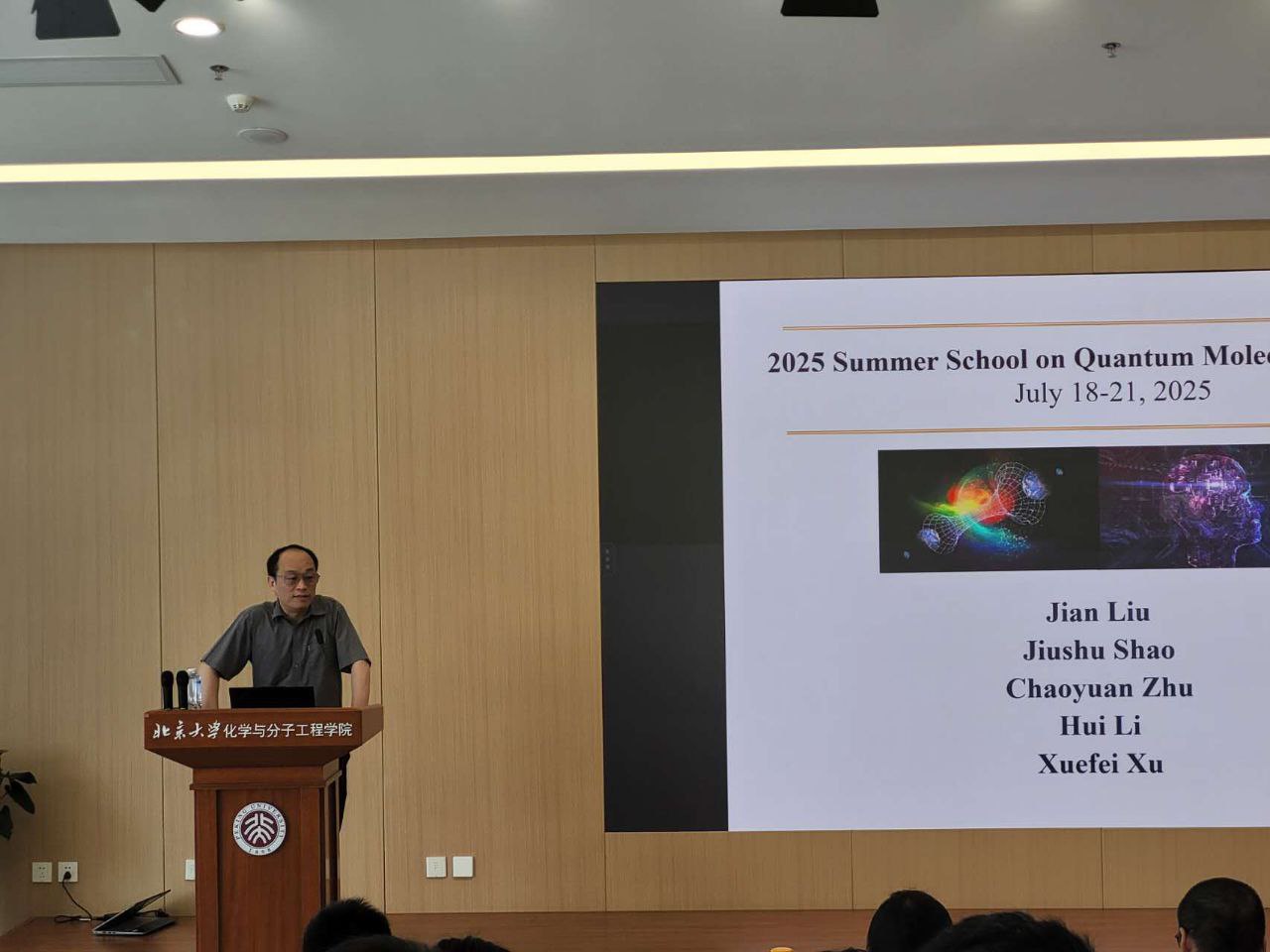
The summer school’s academic programme covered key areas of modern quantum molecular dynamics. Professor Jian Liu opened the lecture series with a fundamental talk on the molecular Hamiltonian and methods for constructing potential energy surfaces—essential concepts for understanding the dynamics of molecular systems. He also paid special attention to approximation issues and modern computational approaches. Professor Hui Li delivered a series of lectures on molecular spectroscopy, giving a detailed overview of vibrational and rotational spectroscopy methods, as well as the distinctive features of spectroscopy for molecules in helium clusters.
Professor Jiushu Shao’s lectures focused on stochastic processes in molecular systems, with a particular emphasis on analytical solutions for various types of potentials, including pioneering results for systems with exponential potentials. Professor Chaoyuan Zhu addressed non-adiabatic transitions, explaining in detail the classical Landau-Zener model and the more modern Zhu-Nakamura model, as well as the surface-hopping method used to simulate electronic dynamics.


A separate block of lectures by Professor Jian Liu focused on computational methods, including classical molecular dynamics, the path integral method, and phase-space formulations. Professor Xuefei Xu presented modern techniques for studying reactive dynamics, including the analysis of elementary chemical reactions. The final lectures highlighted current challenges in applying these methods to real-world research, with examples from Nobel Prize-winning work. Each topic was accompanied by case studies and discussions on the practical aspects of method implementation.
The Russian group also visited the Laboratory of Optoelectronic Materials and Energy Devices led by Professor Huanping Zhou. They met with the professor’s team and discussed ongoing research on perovskite materials. The session took place as part of the joint project ‘Engineering of highly efficient and stable perovskite solar cells’ between the HSE MIEM Quantum Nanoelectronics Laboratory and Peking University’s Laboratory of Optoelectronic Materials and Energy Devices. During the research seminar, postgraduate student Mikhail Samatov and master’s student Emir Amirov presented their work to Chinese colleagues on the fundamental aspects of perovskite physics, including mechanisms of ion migration and methods for controlling the electronic properties of these promising materials.


Professor Zhou stressed the importance of such meetings in strengthening academic cooperation and expressed hope for further collaboration, including joint publications and research projects. The students were also able to see the laboratory’s experimental facilities and latest developments, which proved a valuable experience for their professional growth.
Andrey Vasenko, Professor and Project Leader on the HSE side, noted that the visit of MIEM students and postgraduates to Peking University was an important step in developing cooperation and implementing the joint project: ‘Participation in the summer school and the exchange of experience with colleagues from Professor Zhou’s laboratory not only deepened our knowledge, but also helped outline new areas for joint research. We are confident that such initiatives will strengthen scientific ties and bring us closer to achieving our project goals.’
Informal meetings added a special touch to the trip. Russian and Chinese students spent quality time together, not only discussing science but also exploring cultural aspects. They also exchanged contact information for future communication and cooperation.

Mikhail Samatov, Summer School Participant, Doctoral Programme ‘Electronics, Radiotechnics and Communication Systems’
— Taking part in this summer school was a very important experience, for both my future academic work and developing cooperation with Peking University. The lectures covered complex topics such as stochastic processes and path-integral molecular dynamics, among others. Thanks to the professionalism of the teaching staff, even students without specialised training could grasp the material. The warmth and hospitality extended to us by Peking University reflect the importance of fostering collaboration. I am sincerely grateful to Jian Liu for this opportunity.
Maria Kazantseva, Summer School Participant, Bachelor’s Programme in Information and Communication Technologies and Systems
— I am incredibly happy to have had the opportunity to attend the summer school on quantum molecular dynamics at Peking University. The lectures were quite challenging, but the professors made every effort to make the material as clear as possible. We had the chance to learn new material that was relevant to our interests. After the trip, I am inspired and motivated to continue studying physics and chemistry in depth and strive strive for new heights in science.
Alexandra Musatova, Summer School Participant, Bachelor’s Programme in Information and Communication Technologies and Systems
— Attending the summer school on quantum molecular dynamics at Peking University was a truly enriching experience for me. It was fascinating to work in an international research environment and learn about the development of modern approaches to modelling molecular systems. I particularly recall the lectures given by the organiser, Professor Jian Liu—even the most complicated topics were explained in a way that was easy to understand. I also appreciated the opportunity to interact with other participants and speakers, as well as discussing our research project. One highlight of the even was the meeting with Professor Huanping Zhou, who plays an important role in advancing cooperation between HSE and Peking University—it was a great honour for us. This trip to Beijing broadened my horizons and left me with many vivid impressions. I am grateful for the opportunity and look forward to participating in similar events in the future.
Emir Amirov, Summer School Participant, Master’s Programme in Applied Electronics and Photonics
— Taking part in the summer school gave me the chance to learn about the latest advances in physical chemistry. The lectures were intensive and incredibly useful. Travelling to China allowed me to meet in person such a prominent figure as Professor Jian Liu. For me, this trip was an unforgettable experience.
Timofey Savenkov, Summer School Participant, Bachelor’s Programme in Information and Communication Technologies and Systems
— The trip to Beijing opened up a great deal of new discoveries for me. The topics covered during summer programme seemed challenging, but that only made them more interesting. It was a special feeling to hear a professor lecture on their own theory—as was the case with Chaoyuan Zhu—and even more special to understand what they are talking about! Professor Jian Liu, the organiser of the school, explained the general theoretical foundations in his lectures. Without this knowledge, it would have been much harder to follow the other professors’ lecturers. In our free time, we met with Professor Huanping Zhou’s team, who invited some of my senior colleagues to give a seminar. Her laboratory focuses on finding and analysing materials for solar energy, which is also our goal at our own laboratory at MIEM. I hope that the cooperation between HSE University and Peking University will continue, allowing us to work together. This trip gave us so much: knowledge in quantum physics and chemistry, practice in English, and valuable contacts. I am immensely grateful to my university for this opportunity.

See also:

Scientists Train Neural Network to Generate Process Plans from 3D Models
Researchers at the HSE FCS AI and Digital Science Institute have developed CAD2TechSpec, a framework that converts 3D models of mechanical parts into machining process plans—step-by-step instructions for machine tools. The solution aims to reduce the time required for the design and preparation of technical process documentation in mechanical engineering, aircraft manufacturing, and other high-tech industries. The study findings have been published in PeerJ Computer Science.
Fourth Urbanist Summer School: Students from Across Russia Work on Tikhvin’s Tourism Development
How can tourism be developed in historic areas? How can the interests of residents, tourists, businesses, and local authorities be reconciled? And how can the specific context of a particular city be taken into account when developing project solutions? These were the questions explored at the Urbanist Summer School (USS), which brought together students from leading Russian universities for the fourth time.
Biologists Discover 'Molecular Fingerprint' of Preeclampsia
Researchers at HSE University employed a new method to model hypoxia in placental cells during pregnancies complicated by preeclampsia and identified molecular markers of tissue hypoxia. Since hypoxia is one of the key mechanisms underlying preeclampsia, these findings are important for a more accurate and timely diagnosis of the disease and for the development of effective treatment methods. The paper has been published in Placenta.
‘Hedgehog’ Versus ‘Relatives’: Researchers Measure How the Brain Responds to Unexpected Words During Natural Speech
Russian neurophysiologists, including researchers from HSE University, have demonstrated the feasibility of using event-related fields (ERFs) to study brain activity during natural speech perception. The researchers showed that this approach can be applied not only to individual words but also to continuous speech. Their findings indicate that words whose meanings differ significantly from the preceding context require longer processing times. The study also reveals that the brain processes function words in two stages: first, it identifies their grammatical role and then uses this information to predict the next word. The study has been published in Frontiers in Human Neuroscience.
Hybrid Intelligence: Competencies in the Age of AI Discussed at Technoprom-2026
Artificial intelligence is not creating new professions, but rather transforming the nature of existing ones. This was the conclusion reached by participants in the panel session ‘Hybrid Intelligence: Digital and Human Drivers of Development,’ organised by the Institute for Statistical Studies and Economics of Knowledge (ISSEK) at HSE University as part of the 13th International Forum of Technological Development (Technoprom-2026). The experts discussed how the nature of work is changing, which skills are becoming increasingly sought after, and what prevents companies from fully capitalising on new technologies.
Scientists Develop New Solution for 6G Communication Systems
A terahertz neuromorphic circuit developed by scientists at HSE University could make 6G communication systems both more accurate and energy-efficient. The circuit enables indoor tracking of mobile devices with an accuracy of up to 99%. The results were presented at PIERS 2026, an international symposium on Photonics and Electromagnetism held in China.
Students from HSE and Brest State University Develop Proposals for Development of River in Brest
The Vysokovsky Graduate School of Urbanism at the HSE Faculty of Urban and Regional Development, together with the Department of Urban and Regional Development at Brest State Pushkin University, held a summer school in Brest, Belarus. Over ten days, students from Russia and Belarus studied the Mukhavets River—one of the city’s main natural axes—and developed concepts for its integrated development.
Scientists Develop Algorithm for More Reliable Processors in Data Centres
Researchers from HSE MIEM and Samara University have developed the LRF-3D algorithm to automatically bypass idle nodes in three-dimensional networks-on-chip. Thanks to its hierarchical architecture, the algorithm outperforms existing solutions in both speed and path accuracy, improving processor reliability for use in data centres, supercomputers, and AI computing. The source code and test results are publicly available.
Researchers Develop Method for Direct Generation of Regulatory DNA
Researchers at HSE University have developed a model for generating promoters and enhancers—DNA sequences that regulate gene activity. The model works directly with DNA nucleotides, without first transforming them into a continuous numerical representation. This solution could be useful for applications in synthetic biology and gene therapy. The study results were presented at the ICLR 2026 Workshop ‘Generative AI in Genomics (Gen^2): Barriers and Frontiers.’
Researchers at HSE University and Sber Train Neural Networks to Better Predict User Preferences
The HSE FCS AI and Digital Science Institute and Sber have introduced a new architecture for recommendation systems that combines two classes of models, enabling algorithms to better predict users’ interests and needs. A preprint of the paper has been published on arxiv.org and presented at Urban ML.