

New Method for Describing Graphene Simplifies Analysis of Nanomaterials

An international team, including scientists from HSE University, has proposed a new mathematical method to analyse the structure of graphene. The scientists demonstrated that the characteristics of a graphene lattice can be represented using a three-step random walk model of a particle. This approach allows the lattice to be described more quickly and without cumbersome calculations. The study has been published in Journal of Physics A: Mathematical and Theoretical.
Graphene is one of the most recent and widely discussed materials of the 21st century. It consists of a single layer of carbon atoms arranged in a honeycomb, hexagonal lattice structure. Graphene is exceptionally strong, an excellent conductor of electricity, nearly transparent, and highly flexible. It has already been used in the production of conductive films, sensors, and miniature transistors. Similar structures occur in other carbon forms, such as fullerenes—closed spherical molecules composed of pentagons and hexagons—used in drug delivery and solar cell technology. These materials have numerous structural variants that directly influence their properties, including molecular stability. Experimentally testing each variant is costly and difficult, so scientists are seeking simpler methods to predict their characteristics.
An international team of scientists from Germany, Russia, France, and Japan, including researchers from HSE University, has proposed such a method. They simplified the description of the key parameters that determine the lattice’s behaviour into a three-step random walk model.
In this model, an imaginary particle starts at the origin of a plane and takes three equal-length steps in random directions. The target lattice parameter is then defined by the final position of the particle along the x-axis. Mathematically, this is expressed as the sum of the cosines of three random numbers corresponding to the step directions. For the calculations, it is enough to repeatedly generate random numbers, substitute them into the formulas, and add the results. Repeating this procedure many times yields values that capture the key properties of the lattice. This method describes the material without complex computations and simplifies the analysis.
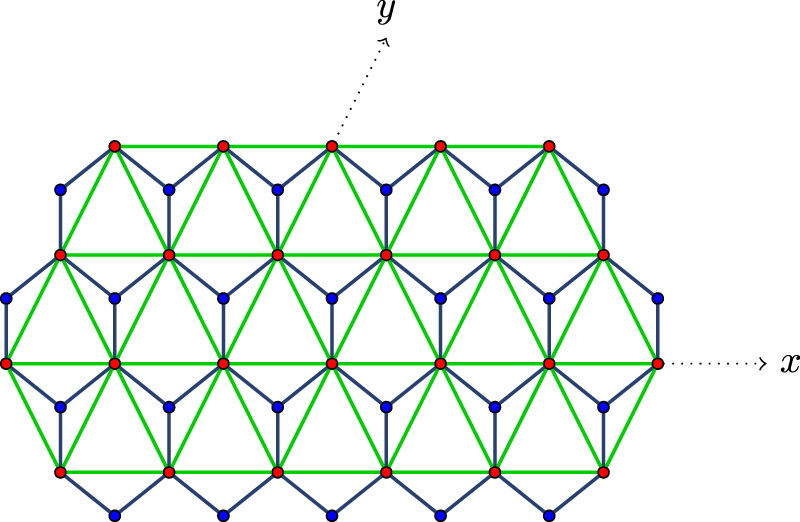
This simplified calculation method is useful not only for graphene. The authors suggest that their approach could also be applied to other carbon structures, such as fullerenes.

Victor Buchstaber
'We hypothesised that as the size of a molecule increases, random fullerenes become locally more similar in structure to an infinite graphene lattice. If this can be rigorously proven, the spectral properties of fullerenes could be derived from those of graphene, greatly simplifying their analysis,' explains Viktor Buchstaber from the International Laboratory of Algebraic Topology and Its Applications at the HSE Faculty of Computer Science.

See also:

AI Users Earn Up to 41.8% More Than Non-Users
Research conducted by economists at HSE University has revealed a significant correlation between the regular use of GenAI in the workplace and higher pay among Russian employees. The study found that individuals who frequently use GenAI in their professional activities earn notably more than those who reject these new tools or resort to them occasionally. The salary premium for highly qualified specialists reaches 41.8%. The article was published in the Voprosy Ekonomiki journal.
Personal Interest in Doctoral Thesis Topic Most Important for Confidence in Successful Defence
A researcher at HSE University analysed data on 1,539 doctoral students from 161 Russian universities to identify which features of a thesis topic are associated with academic success and engagement. The most important factor was found to be personal interest in the research topic, which was associated with almost all key aspects of doctoral programme experience—from engaging with the academic supervisor to research activity and confidence about successfully defending the thesis. The findings have been published in Higher Education.
Researchers Develop Methodology to Assess the Quality of Legal Representation in Criminal Proceedings
Having a good defence attorney in criminal proceedings can largely determine whether a defendant retains their freedom, health and good name. Researchers at HSE University propose a method for predicting an attorney’s performance based on the outcomes of their previous cases. The methodology takes into account the severity of the charges, the complexity of the cases, and the most likely outcome, drawing on judicial statistics.
When Pictures Hinder Understanding: Illustrations May Impede Learning of Abstract Ideas
Illustrations can help remember specific actions but do not always make abstract ideas easier to learn. Researchers from HSE University and Humboldt University compared how people learn from texts with different levels of abstractness. They found that participants remembered illustrations better and performed better on related tasks after reading a multimedia text about yoga asanas than after reading an abstract text about the Nash equilibrium. The findings could help improve the selection of illustrations for educational and informational materials. The study has been published in Learning and Instruction.
HSE Researchers Present Study on Neural Network Robustness in Video Analysis at ChinaMM 2026
Researchers from HSE University presented a study at the international ChinaMM 2026 conference on how video transmission distortions affect the performance of neural networks. The authors proposed a new approach to testing the robustness of such models under conditions that closely resemble the real-world use of video services.
HSE University to Develop Predictive Analytics System for Icebreaker Motors
Industrial automation is one of the key applications of artificial intelligence. A predictive analytics system for large electric motors is among the solutions being developed for the industry as part of HSE University’s Strategic Technological Project ‘Multi-Agent Platform of AI Solutions for Industry-Specific Tasks.’ What is predictive analytics, how can it improve the operation of electric motors, and what specialists joined forces to develop this technology? Anton Zarubin, Dean of the School of Computer Science, Physics, and Technology at HSE University–St Petersburg and the project development coordinator, explains in this interview with the HSE News Service.
Scientific Expedition to Hainan: HSE Scientists Organise Conference on Statistical AI in China
The Statistical AI Conference was held in Sanya, Hainan Island, China, from 24 to 28 August 2026. The international event brought together leading experts in statistics, machine learning, and applied AI. Alexey Naumov, Director of the AI and Digital Science Institute at the HSE Faculty of Computer Science, and Sergey Samsonov, Head of the International Laboratory of Stochastic Algorithms and High-Dimensional Inference, were among the conference organisers.
How to Assess Students’ Knowledge in the Age of AI
A researcher at HSE University has proposed a flowchart to help lecturers decide how to assess students who use artificial intelligence. It shows where the use of AI should be restricted and where it can be incorporated into the learning process. The article has been published in IT Professional.
5th Fall into ML Conference to Bring Together Leading AI Researchers
The AI and Digital Science Institute at the HSE Faculty of Computer Science invites researchers, developers and everyone shaping the future of technology to the fifth, anniversary edition of the Fall into Machine Learning conference (Fall into ML 2026). The event will take place on October 23–24, 2026, at the HSE Cultural Centre in Moscow and will become the key meeting point for Russia’s AI community.
HSE University Expands Cooperation with Malaysia in Technology Foresight
HSE University researchers will take part in a study of the future of engineering education in Malaysia, while the Malaysian Industry-Government Group for High Technology (MIGHT) will use the iFORA big-data analysis system to validate the findings of its foresight research. These are the outcomes of a visit by HSE representatives to Kuala Lumpur.