

Physicists Propose New Mechanism to Enhance Superconductivity with 'Quantum Glue'

A team of researchers, including scientists from HSE MIEM, has demonstrated that defects in a material can enhance, rather than hinder, superconductivity. This occurs through interaction between defective and cleaner regions, which creates a 'quantum glue'—a uniform component that binds distinct superconducting regions into a single network. Calculations confirm that this mechanism could aid in developing superconductors that operate at higher temperatures. The study has been published in Communications Physics.
Superconductivity is a state in which electric current flows through a material without resistance, losing no energy as heat. In ordinary conductors, electrons move independently and lose energy through collisions with atoms and impurities. In superconductors, however, electrons form Cooper pairs and move in unison, enabling current to flow without loss. Thanks to this property, superconductors are used to create powerful magnets, medical MRI scanners, and particle accelerators, and they also hold promise for developing new types of computing devices.
The challenge is that superconductivity usually occurs only at very low temperatures and is easily disrupted by impurities and defects in the material. These defects fragment superconductivity into isolated regions that fail to connect. Paradoxically, however, such disordered areas can also support the formation of Cooper pairs at higher temperatures. This creates a contradiction: structural disorder can locally enhance superconductivity, yet at the same time prevents it from spreading throughout the entire sample.
A team of researchers from HSE University, the Moscow Centre for Advanced Studies, and the Federal University of Pernambuco has shown that this challenge can be addressed by combining defective ('dirty') and clean subsystems. The team studied a two-band model in which one subsystem is highly disordered: superconductivity emerges there at higher temperatures, but only in isolated regions. The other subsystem remains clean, where superconductivity is weaker but provides connectivity. When the two are combined, a component arises that acts as a 'quantum glue,' linking the isolated islands and enabling current to flow through the entire sample at elevated temperatures.

Alexei Vagov
'Our calculations show that when defective and clean regions are properly connected, the material exhibits both a higher superconducting transition temperature and the ability to carry current without resistance. While disorder usually destroys this effect, we observed the opposite: defects can serve as a resource for creating more stable superconductors that operate at higher temperatures,' explains Alexey Vagov, Professor at HSE MIEM and co-author of the study.
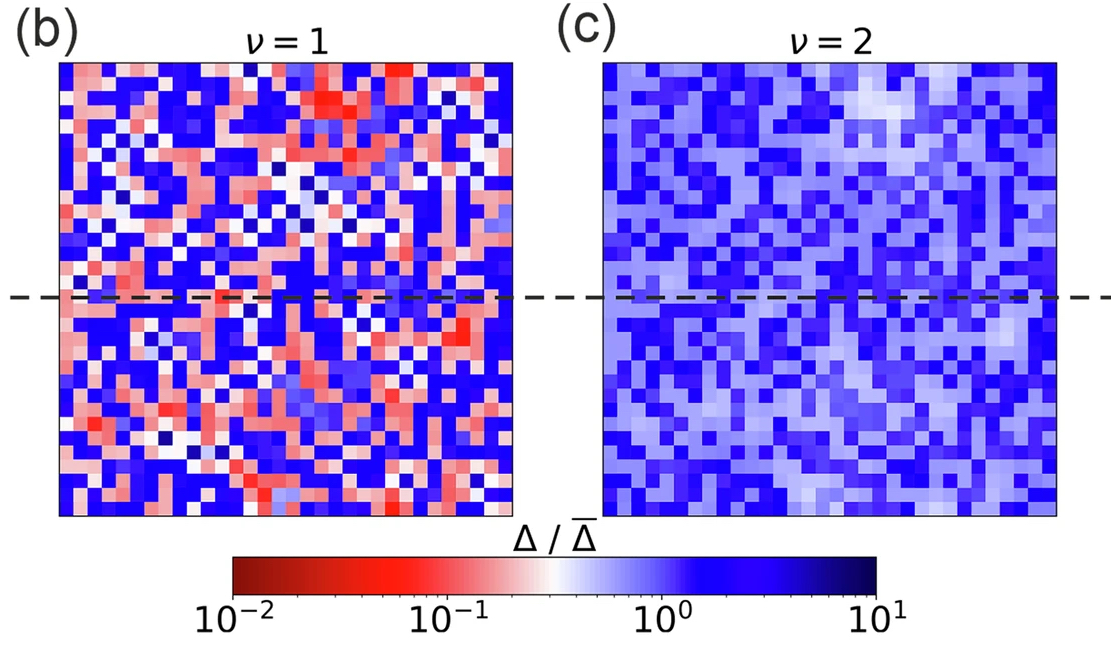
Calculations confirm that this approach is effective for various types of disorder, ranging from random impurities to specially engineered superlattices. It is particularly promising for multilayer materials, where clean and disordered layers can be alternated; for compounds based on magnesium and boron (MgB₂), in which one electronic band enhances local superconductivity while the other facilitates current flow; and for materials with flat electronic bands, where electron pairing occurs more readily. Graphene- and graphite-based systems are also considered promising, as regular superstructures can form that alter electronic properties and promote stronger superconductivity. In the future, this could enable the development of materials in which defects and impurities do not hinder, but rather enhance, superconductivity.
The study was conducted with support from the Russian Science Foundation (Project 075-15-2025-010) and the HSE Basic Research Programme, using the university's HPC cluster.

See also:

‘Hedgehog’ Versus ‘Relatives’: Researchers Measure How the Brain Responds to Unexpected Words During Natural Speech
Russian neurophysiologists, including researchers from HSE University, have demonstrated the feasibility of using event-related fields (ERFs) to study brain activity during natural speech perception. The researchers showed that this approach can be applied not only to individual words but also to continuous speech. Their findings indicate that words whose meanings differ significantly from the preceding context require longer processing times. The study also reveals that the brain processes function words in two stages: first, it identifies their grammatical role and then uses this information to predict the next word. The study has been published in Frontiers in Human Neuroscience.
HSE Researchers Create New Corpus of Early Child Speech in Russian
Researchers at the HSE Centre for Language and Brain have presented RusLan-M, an open multimedia corpus that makes it possible to trace the development of early child speech in Russian from first words to the emergence of complex grammatical constructions. The database contains around 41 hours of video recordings and more than 35,000 child utterances. The new resource will help researchers study more precisely how children acquire Russian and, in the longer term, develop more reliable tools for assessing speech development. The study has been published in Language Resources and Evaluation.
Hybrid Intelligence: Competencies in the Age of AI Discussed at Technoprom-2026
Artificial intelligence is not creating new professions, but rather transforming the nature of existing ones. This was the conclusion reached by participants in the panel session ‘Hybrid Intelligence: Digital and Human Drivers of Development,’ organised by the Institute for Statistical Studies and Economics of Knowledge (ISSEK) at HSE University as part of the 13th International Forum of Technological Development (Technoprom-2026). The experts discussed how the nature of work is changing, which skills are becoming increasingly sought after, and what prevents companies from fully capitalising on new technologies.
Scientists Develop New Solution for 6G Communication Systems
A terahertz neuromorphic circuit developed by scientists at HSE University could make 6G communication systems both more accurate and energy-efficient. The circuit enables indoor tracking of mobile devices with an accuracy of up to 99%. The results were presented at PIERS 2026, an international symposium on Photonics and Electromagnetism held in China.
Scientists Develop Algorithm for More Reliable Processors in Data Centres
Researchers from HSE MIEM and Samara University have developed the LRF-3D algorithm to automatically bypass idle nodes in three-dimensional networks-on-chip. Thanks to its hierarchical architecture, the algorithm outperforms existing solutions in both speed and path accuracy, improving processor reliability for use in data centres, supercomputers, and AI computing. The source code and test results are publicly available.
Researchers Rank Recommendation Algorithms Using Sports Tournament Model
Researchers from the AI and Digital Science Institute at the HSE Faculty of Computer Science have developed an approach for selecting recommendation algorithms more effectively. Their approach uses pairwise comparisons of algorithms to create a tournament table, with the overall ranking based on their performance across all datasets in the tournament. This can reduce the number of algorithms that need to be tested when developing new services, saving both time and money. The study was presented at the 32nd ACM SIGKDD Conference on Knowledge Discovery and Data Mining (KDD 2026).
Researchers Develop Method for Direct Generation of Regulatory DNA
Researchers at HSE University have developed a model for generating promoters and enhancers—DNA sequences that regulate gene activity. The model works directly with DNA nucleotides, without first transforming them into a continuous numerical representation. This solution could be useful for applications in synthetic biology and gene therapy. The study results were presented at the ICLR 2026 Workshop ‘Generative AI in Genomics (Gen^2): Barriers and Frontiers.’
Researchers at HSE University and Sber Train Neural Networks to Better Predict User Preferences
The HSE FCS AI and Digital Science Institute and Sber have introduced a new architecture for recommendation systems that combines two classes of models, enabling algorithms to better predict users’ interests and needs. A preprint of the paper has been published on arxiv.org and presented at Urban ML.
Physicists Discover What Happens Inside a Stable Vortex
Large vortices with characteristic spiral arms are often observed in the atmosphere and the ocean. Physicists from HSE University have explained how these structures form and why they retain their shape. The researchers found that velocities at points located along the same vortex arc remain correlated even over long distances. At the same time, this correlation weakens rapidly with increasing distance from the vortex centre. These differences help explain the formation of spiral arms and may improve models of atmospheric and oceanic currents. The findings have been published in Physical Review Fluids.
HSE Computer Science Researchers Win Gold Medal at International Machine Learning Competition
A team comprising HSE International Laboratory of Statistical and Computational Genomics researchers Aleksei Shmelev and Nikita Chervov, 2025 graduate of the HSE Faculty of Computer Science’s Master’s programme in Data Analysis in Biology and Medicine Ivan Gevorkov, and two students from the United States achieved an outstanding result at the 2026 NeuroGolf international machine learning championship. The team won a gold medal and placed seventh overall.